
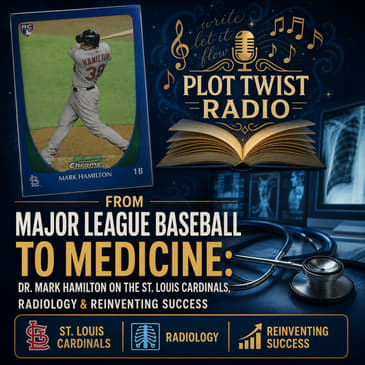
What happens after reaching the highest level of professional sports?
In this episode of Plot Twist Radio, former St. Louis Cardinals first baseman and World Series champion Dr. Mark Hamilton shares his remarkable journey from Major League Baseball to becoming a physician and radiologist.
Mark reflects on his path through Tulane University, the College World Series, being drafted by the Cardinals, playing alongside stars like Albert Pujols, and competing in historic ballparks including Wrigley Field and Busch Stadium. He also discusses the transition from professional athletics to medical school, the lessons baseball taught him about leadership, resilience, teamwork, and patient care, and why he ultimately chose a career in radiology.
We also talk about:
• Life in the St. Louis Cardinals organization
• The pressure of playing in Major League Baseball
• His favorite MLB stadiums and toughest pitchers
• Winning championships at every level
• How sports prepared him for medicine
• Building trust with patients
• The emotional realities of healthcare
• Advice for athletes planning life after sports
• Finding purpose beyond your first dream
Whether you're a baseball fan, healthcare professional, student, or someone navigating a major life transition, Dr. Mark Hamilton's story is a powerful reminder that one successful career doesn't have to be your last.
#MarkHamilton #MLB #StLouisCardinals #Baseball #Radiology #Medicine #Healthcare #WorldSeries #Tulane #Sports #Podcast #PlotTwistRadio
[00:00:00] Welcome to Plot Twist Radio, the show where creativity, storytelling, and the unpredictable path of the creative life all collide. I'm your host Erin Egnatz. Hi Mark, welcome to Plot Twist Radio. Hi. Thank you for joining me. Before we get going, can you tell the audience a little bit about yourself? Yeah, absolutely. So my name is Mark Hamilton. I'm a former Major League and Minor League Baseball player, played nine professional seasons with Boston, St. Louis, and Atlanta.
[00:00:27] Parts of two seasons in the Major Leagues with St. Louis, and part of the regular season 2011 team that went on to win the World Series. Following that, I actually went back, finished a degree in Neuroscience at Tulane University, and then went to the Zucker School of Medicine at Hofstra Northwell, where I got my MD. And I am now in my final year of training at NYU as a radiologist, and will be an attending radiologist at Robert Wood Johnson Barnabas Health starting in July.
[00:00:57] Very cool, and congratulations. That's quite the accomplishment. Thank you. For sure. So, you come from a family of physicians. Your father was a physician as well. Growing up, did you always envision yourself following in medicine, or was baseball always the first dream for you?
[00:01:13] It's kind of an interesting plot twist for that, actually. So my grandfather played professional basketball. He played professional basketball in the era where professional sports were not as lucrative as they are now, and travel was very different. So when my father was born, he actually retired from professional basketball.
[00:01:31] He was playing with the Fort Wayne's Pistons so that he could be closer to home. And then my father was born, and he fell in love with medicine from a young age, ultimately becoming a research physician, and was the director of pathology and lab medicine at both MD Anderson Cancer Center in Houston, as well as the director of pathology and laboratory medicine at the City of Hope in LA.
[00:01:55] And I kind of grew up with this interest in my grandfather, and, you know, an interest in what my dad did. He was doing all this groundbreaking research at the time at Johns Hopkins when I was real young, where he was assistant director of pathology.
[00:02:10] And, you know, dinner table conversations were molecular genetics kind of at the time in the 80s when this was all very new and cutting edge. It's now the kind of stuff we learn about in med school. And I just grew infatuated with it. But at a young age, I really, you know, kind of, I was a good baseball player. And I kind of wanted to follow that dream and play professional athletics as well. Very cool. So when did you realize baseball might be more than just something you loved?
[00:02:40] I mean, if you ask me, it was when I was like six years old. But you know, I think realistically, as I got towards high school, when I was probably 11, 12 years old, I was already playing on, you know, the high school varsity level summer teams.
[00:02:57] I was in Houston at the time we had just moved to Houston, my father took the job at MD Anderson, and they allowed you to play up a level if you were good enough. And at that point in time, I was good enough. And Houston baseball was outstanding. I mean, I was getting to go out on the field, I was 13 years old playing with Josh Beckett and Scott Casimir and Troy Patton and other guys that, you know, ended up being big leaguers.
[00:03:21] And it was kind of clear that I was at least going to be on track to play college ball at minimum, I think, you know, knowing whether you're not going to play in the big leagues is impossible to know.
[00:04:01] And it was a way to lay the groundwork to pursue both. Very cool. And very smart, too. So you went to college at Tulane, correct? Yes. And you guys made the College World Series. What's the most from that experience for you?
[00:04:17] It was incredible. That season was something very special to play, you know, on TV in the College World Series growing up. That was kind of the first thing you look at, you know, obviously, you watch a lot of big league baseball and stuff like that. But I was always young, you know, loving watching the College World Series. At that point in time, interestingly enough, it was like University of Texas and LSU and some of these other, you know, big SEC schools that were kind of perennial in the finals or semifinals and being able to watch that on ESPN.
[00:04:46] And I kind of from a young age, I wanted to play in the College World Series. That was really a dream come true to, you know, step out on the field of Omaha. I homered in a game against Baylor, ironically, off a teammate of mine who was on one of my summer ball teams. And it was just kind of a surreal experience to, you know, taste that kind of big audience, you know, play in front of a lot of people in a big stadium, kind of on a big stage for the first time.
[00:05:11] I can imagine. So take me back to when you were drafted. What did that feel like? It was awesome. I mean, it was one of those things I had originally out of high school. I had a lot of interest. You know, I played on at the time, you know, now it's a relatively big thing at the time. It was kind of a little less known, but a little more obscure, but called the area code games where scouts from your region would have tryouts and pick a team to go out.
[00:05:41] And we played at Long Beach State University. And then from there, I played on the Goodwill Games, United States team. And that was kind of the first time I started saying, like, you know what, maybe I skip college. Maybe I, you know, go straight into professional baseball. A lot of the people on the team I was on actually ended up getting drafted very high. You know, I got pretty good advice. Someone basically told me, figure out what the college experience is worth to you.
[00:06:08] Put a number on that and just be forthcoming with scouts. Tell them this is the number that I need to forgo college. And if you don't get it, then move on. And I kind of had a number. Obviously, that number was higher than they were willing to give me. So I actually went undrafted, which was a little bit of a surprise for some people because I was kind of a relatively high prospect out of high school. But they were kind of aware that I was not going to sign if I didn't get what I was asking for.
[00:06:37] And then, you know, what I was asking for was too much. So from there, I went to college. I majored in cell and molecular biology for three years and really kind of got my feet under me, developed as a player and ended up getting drafted in the second round by St. Louis. Very cool. So this is something that I've asked all the major leaguers that I've interviewed. What was your favorite park to play in? The St. Louis fans will hate me, but it was Wrigley.
[00:07:07] Look, St. Louis is amazing, but St. Louis, when I went there and was playing in St. Louis, was the new Bush Stadium. There's something about Wrigley Field. It's been there since the late 1800s, and you're stepping into the same batter's box as, you know, every left-handed, Ernie Banks, Babe Ruth, Ted Williams, everybody. I mean, you could just, the list goes on and on. And to step into that batter's box and have that history and just be literally in the footsteps of Giants was something else.
[00:07:35] And, you know, obviously playing in St. Louis was incredible, and we had sellout crowds every night, and it was amazing. But there was something very special about that. Similar to, you know, I got to play in Fenway a couple times in exhibition games, and that same feeling of just kind of stepping in a field. It's like a cathedral of the game. It's been there for a century or more. And just kind of being a part of that history was really, truly amazing. Oh, yeah. I've been to a ton of ballparks, and I'm a White Sox fan. I grew up a White Sox fan.
[00:08:05] I'm right outside of Chicago. But Wrigley's better. That's got to be tough being a White Sox fan. It is. It is. They're so bad. They're always so bad. I'm also a Dodger fan, so it kind of evens out. They have some, they have a new exciting player this year, though. Yeah. From Japan. Yeah. He's impressive, to say the least. He is. Yeah. I took my son to a game the other day, and now he's hooked. You know, he never really cared about baseball until the White Sox actually showed up and played this time. I was really thankful for that. And now he's hooked.
[00:08:34] That's awesome. Yeah. Now I got to get him over to Wrigley because hopefully he won't become a Cubs fan. Sorry, all you Cubs fans up there, but that would kill me. But Wrigley's cool. Something special about those places, right? There's only a handful of ballparks that are left, you know, that have been there since the dawn of, you know, the dawn of time, at least effectively from baseball. And there is something about being in that. It's like going to Notre Dame or something like that. Like you're just somewhere that there's been so much history.
[00:09:04] There's been so many other great people and great, you know, things have happened, and there's something about it that's just different. Yeah, I agree for sure. So thinking back on your career, who was the hardest pitcher you ever faced? That's easy. It was Carlos Marmol. So it's an interesting story about that. So, you know, Marmol was, he went through some ups and downs in his career.
[00:09:29] But the years I was with the Cardinals in the big leagues coincided with his absolute prime of his career. And there was specifically, I think it was 2011, that he set the all-time, he like got Rolaid's relief man of the year. And he set the all-times K per nine for reliever. He struck out like 120 guys in 70 innings or something like that. And I think he got me like eight times that year. He threw six different sliders.
[00:09:58] You never knew what it was going to do. You know, and he threw hard on top of that. It was just, he made everyone look silly. And, you know, being someone that was coming off the bench, kind of, I've joked with my friends, you know, people have always asked me, what's it like to pinch hit in the big leagues? Like that's, you know, because that was my role. I never was really a starter. I was behind Albert Pujols my whole career. And, you know, obviously if you're behind Albert Pujols, a generational player, you're not going to get a whole lot of playing time.
[00:10:25] So my role was to come off the bench late in the end, you know, late in the game, pinch hit for the pitcher. National League at that time had no designated hitter. And, you know, try to face one of these guys late in the game. And it seemed like every other game that I came in, I was facing Carlos Marmol or Kerry Wood. And those two guys were just nasty. I mean, they were, you know, as build, incredibly impressive.
[00:10:48] And especially if you've been sitting on the bench, I used to liken it to saying, you know, imagine you're one of the people in the pit of a Formula One race and you've been changing tires all day. And all of a sudden the driver jumps out and says, hey, take a lap. But, you know, all of a sudden you're going 230 miles an hour and trying not to hit the wall. Good analogy. So before we pivot away from baseball, do you have one memory that sticks with you that will always trump all the rest?
[00:11:17] Yeah, I mean, I have a few. And interesting enough, some of them aren't in the big leagues. You know, my team 2009 in Memphis, we won the Pacific Coast League. And a lot of those guys ended up being on that same 2011 team. David Freeze, Alan Craig, John Jay, Shane Robinson. I mean, just the list goes on and on. And really, you know, Adam Adovino, that team was special. And that season was special. And it was like my first season in AAA.
[00:11:44] And really, you know, since college, college ball is different. It's all about winning. And you get to professional baseball and it's obviously you still want to win, but there's a lot more individual. People are trying to advance. And it's not quite the same. And that was the first time I felt like I was really on a team that the goal was to win. Like we went out every night to, you know, just go after the team we were playing. And it was an incredible year.
[00:12:12] You know, and obviously the following year I ended up in the big leagues. And I have some great memories from the big leagues too and stuff like that. But, you know, I don't think anything will trump that 2009 season of winning the entire league. And just being around those guys and guys that went on to have incredible careers. Very nice. I like that. I like that it's that big major league memory, really. That's because that's what you usually hear. But, you know, people don't really think about the grind to get to it and the camaraderie and everything that comes with a team. So it's really nice to hear.
[00:12:42] Let's pivot to medicine. I have to say before we get going on this, I actually, you know, I've had a lot of jobs. I'm a professor of history. I'm a writer. I'm a host. But I started as a CNA. And I will tell you, the medical field was the hardest field I've ever worked in. How do you handle that? It's challenging. You know, a lot of times, and I always got asked this whenever I was interviewing, they said, you know, how do you think baseball is going to approach, you know, be, how do you think the skills you learn in baseball are going to apply to medicine?
[00:13:11] And the reality with medicine is you deal with patients. Those patients have never met you before and they need something from you. And in a way, kind of in kind of a tangential way, but in a similar way, that's kind of how it is playing in front of fans. You know, you never know who's going to see you play for the first time.
[00:13:28] You never know, you know, who's going to be sitting in the front row and you're going to inspire them or change the way they see the world, you know, by your performance or by an act of kindness, signing an autograph, giving them kind of a personal touch. And I felt a lot of the similarities of being able to walk into a patient's room and create, you know, a sense of bond, a sense of camaraderie there that, you know, I'm here to help them. I they have goals.
[00:13:58] I need to know what those goals are so we can work together to achieve an outcome. And at the end of the day, I really think that baseball helped me along my journey by allowing me those kind of people skills to walk into a room, someone you've never met before and create some kind of rapport. And that rapport, you know, especially in medicine matters so much. It's incredible what a relationship or what trust can do.
[00:14:25] You know, when you're a physician, when, you know, now as radiologists, I don't see patients as directly, but I work in an outpatient imaging center and it's not infrequent that a patient has a question or they have a reaction to an injected contrast or they have a concern about something that we're going to do as part of their imaging study. And to be able to walk in and create that bond with them immediately to gain that trust and kind of have that confidence to walk in and say, hey, I'm here to help you. I can do something for you.
[00:14:53] You know, how can I make your day or your appointment better? Those are things that I definitely got skills from in baseball and something I think is, you know, absolutely crucial in medicine. It really is. It makes a huge difference. Like, like I said, I worked with some doctors who had no people skills and it never went well. I specifically worked in hospice. Hospice is tough. It is very tough. It's very tough. Yes. How do you not bring it home with you?
[00:15:22] That was something I always had a hard time with. You know, to some degree, I think it's impossible not to bring it home with you. And part of the importance is understanding that there is a layer of separation there. But also I learned from my patients. You know, I learned life lessons from them. Unfortunately, in radiology, you know, modern radiology, a lot of what we do is follow-up imaging, at least in the outpatient world. And we have a lot of patients who have extremely tough diagnoses who may be headed towards hospice.
[00:15:51] And it gives you, you know, you have kind of two options. You can either allow it to bring you down and say, look at the world and look at these things that are happening to people. Or you can look at how people are fighting through things and gain an appreciation of what you have, gain an appreciation of how important health is, and to, you know, what kind of difference you can make for people. And there's always something there.
[00:16:16] There's always something with a patient, even who's in the worst possible way, to make that an easier moment for them, an easier transition, make something more clear. And there's something uniquely rewarding to that. And I think if you can really hone in on the positive aspects of what you're doing for people, rather than focusing on the negative sides of the diagnoses or illnesses they may be combating,
[00:16:43] and kind of see that human element, there's something that's uniquely positive and hopeful there. And I try to focus on that. Now, obviously, you know, medicine can be tough. And sometimes, especially, you know, in my early career when I was working in a hospital, you definitely see negative outcomes. And then it really becomes about, you know, the survivors or about the family or who can you help?
[00:17:07] And there's always someone there that needs reassurance or needs clarity, something that you can provide. And if you can be the one to offer that to them, offer them something, you know, maybe not even hope, but clarity, it means a lot to them. And to kind of understand how important that is and the gravity of that offering, it really brings a lot of, you know, positive and kind of uplifting vibe to it all.
[00:17:37] Yeah, absolutely. So what made you pick radiology? It's an interesting path. I mean, so I think ultimately I ended up being more like my dad than I thought. You know, my dad was a pathologist. And, you know, he and I still talk a ton about medicine and kind of our different journeys. He deals with the micro side of diagnosis. So looking at something under the microscope, looking at someone's cells, I'm looking at the macro. I'm looking at the images. I'm looking at the organ systems.
[00:18:06] So that kind of detective work, I think, at the end of the day really just spoke to me. To be able to someone to kind of put that puzzle together or kind of help the care team find what the next step needs to be seemed really important to me. You know, I initially, I think every athlete that goes into medicine wants to do orthopedic surgery. And I initially was the same way. I went in, I said, I'm going to do orthopedics from the get go. I'm going to do this. And my grades were there.
[00:18:35] But at the end of the day, I felt like I was missing some of the aspect, broader aspects of medicine. Orthopedics become so focused on certain body systems and kind of like physiology and other aspects of medicine. Radiology allowed me to have a little more general sense of, you know, what's going on with the patient. And a broad range of diagnoses ranging from sometimes orthopedic things, sometimes, you know, cancer, sometimes infectious disease.
[00:19:03] And kind of maintaining that ability to have a general and global sense of medicine seemed really important to me. And that ultimately drove me into, you know, the field I'm in. Very interesting. I have one last question for you. Sure. If you could go back and talk to pre-draft you, what would you tell them? You know, it's an interesting thing. I think the thing that I would go back and tell myself is to enjoy the moment and worry less.
[00:19:32] You know, one of the things when you're a young person playing baseball, it's weird, right? So you start as a young kid and you don't think about any of these things. It's just like go to practice and work hard and, you know, try to win the game. And then it's like as you get closer and closer to your goal of being a major league player, there's a lot of focus or anxiety, things like that about your performance, about, you know, kind of nitpicking and overanalyzing at times.
[00:20:01] I think if I could go back and tell, you know, from a baseball perspective and say, what could I do differently or what would I do differently? It would be just kind of enjoy the ride more. And, you know, be less hyper-focused on every single pitch, every single, you know, swing, every single mechanics, all that stuff. And just be more free and easy and allow your ability to show. You know, I think overall I did a very good job and I had an excellent career.
[00:20:27] But I think that if I could go back and just enjoy it more and kind of see it less as trying to accomplish a goal and more as being in the present, I would be even more successful. And, you know, I try to apply that to medicine now because, you know, being older, I think it was a huge advantage going into medicine a little older, a little more mature, having gone through one very difficult career, that I can kind of see it a little bit more big picture.
[00:20:57] And appreciate the things that I can do for people, not hyper-focus, you know, on every little aspect, but try to focus on the positives more. Well, thank you so much for joining me. This has been a wonderful conversation. Of course. Thank you so much.