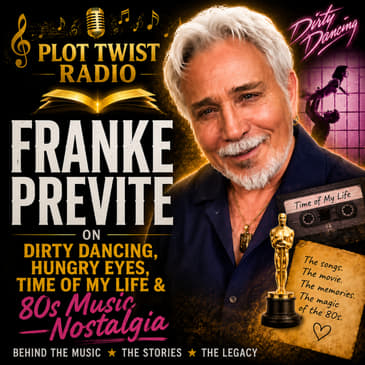
Franke Previte joins Plot Twist Radio for a nostalgic deep dive into the music, magic, and legacy of Dirty Dancing.
In this episode, Franke shares the incredible true story behind writing the Academy Award-winning classic “(I’ve Had) The Time of My Life,” the origins of “Hungry Eyes,” and how a small film nobody expected to succeed became one of the most beloved movies of all time.
We discuss:
• The chaotic creation of Dirty Dancing
• Patrick Swayze and Jennifer Grey behind the scenes
• Writing iconic 80s movie songs under pressure
• Winning an Oscar and Golden Globe
• The surprising story behind keeping his publishing rights
• Frankie and the Knockouts
• Vinyl records and music nostalgia
• Why 80s music still resonates today
• The emotional legacy of Dirty Dancing decades later
Franke also shares never-before-heard stories about the film’s ending scene, meeting Patrick Swayze at the Academy Awards, and how the soundtrack unexpectedly changed the trajectory of his entire life.
If you love 80s nostalgia, classic films, songwriting stories, vinyl culture, or behind-the-scenes music history, this episode is for you.
#DirtyDancing #FrankePrevite #80sMusic #PatrickSwayze #HungryEyes #TimeOfMyLife #80sNostalgia #JenniferGrey #ClassicMovies #VinylRecords #Songwriting #PopCulture #PlotTwistRadio
[00:00:00] Welcome to Plot Twist Radio, the show where creativity, storytelling, and the unpredictable path of the creative life all collide. I'm your host, Erin Egnatz. Hello and welcome to the show. It's great to be here. Thanks for having me, Erin. It's great to have you, I should say. My brain's not working this morning. Before we get going, can you introduce yourself to the audience?
[00:00:23] My name is Frankie Previtz, and I am a, I started out as a singer-songwriter, and then I became, after Dirty Dancing, a songwriter-songwriter. I love it. And two of the best songs, I've been listening to them on repeat since Ann Marie told me I would have you on the show. When you first got into music, did you see yourself as winning an Academy Award?
[00:00:52] Not really. My dad was an opera singer, so music was always going on in my house. And, you know, for me, at the age of 10, my father had me singing for charity events to raise money for cerebral palsy. Or, you know, and the singing song says the 10-year-old Be My Love by Mario Lanza.
[00:01:10] So, I had no idea, but I knew that the accolades from hearing the audience respond to me gave me this feeling of, you know, this is something cool and something I enjoy doing. And then, you know, I would go to Christmas events at my grandmother's, you know, and she'd go, Frank, come on, sing. And, you know, she'd want me to sing, and I'd go, Grandma, give me 25 cents.
[00:01:38] And so, I knew there was some kind of income I could make from it. That's smart. It was always in my blood. And, you know, at 13, I put a group together with my cousin Joey Alessi called, believe it or not, Frankie Love, L.U.V., and The Intruders. And at 15, we got a record deal on Roulette Records. And, you know, my parents at the end of high school wanted me to go to college, which I didn't want to do.
[00:02:07] I wanted to be a singer. And then they told me, hey, you know, you graduate college and you can be anything you want to be. So, instead of going to graduation, I was on the road with a rock and roll band. And here I am talking to you. And you know what? I told my parents I wasn't going to college, but then I didn't really do anything, so I had to go to college. I can't sing, though, so there's a difference there. Well, you know, I think the singing part came easy to me.
[00:02:34] The songwriting part was something that really, you know, took me time to write and rewrite. You know, there are prolific songwriters like Bruce Brankstein or, you know, Bob Dylan or Stevie Wonder, but I'm not one of them. You know, I'm a guy that's got to get in the trenches and probably rewrite my song like 10 times before I'm happy with it. And so, you know, that took a while.
[00:02:59] But my voice always got me into recording studios because people, you know, would give me demo time. Oh, he sings really good. You know, I bring him in here, you know. And my songs were never as good as my voice until, you know, many years of selling cars out of my driveway so I wouldn't have to join a cover band. I, you know, my parents loaned me 300 bucks. I bought a piano. My cousin, Dusty McCallie, taught me how to plunk out some chords.
[00:03:26] And I wrote my first hit in 1981 called Sweetheart, which was a band called Frankie and the Knockouts. And that song went top 10. And then I had two other hits in that band that went top 20 without you and you're my girl. And then Frankie and the Knockouts kind of broke up after Jimmy Einer, the president of Millennium Records, decided that he wanted to go into film. And so now I'm back home trying to get another record deal.
[00:03:55] And two years later, Jimmy Einer calls me the same guy who shut his label to go into film and said, Frankie, I got this little movie I'm working on. I want you to write a song for it. I said, Jimmy, I'm really too busy to do any of that. I'm trying to get another deal. You know, I'm selling cars out of my driveway. He goes, no, man. He goes, this is a good little. I said, all right. What's the name of the movie? And when he said Dirty Dancing, I was like, oh, no, he wants me to write to a porn movie.
[00:04:23] But he goes, no, it's a good little movie. And he gave me like a five minute description. Baby meets Johnny. The father doesn't like the kid, but they end up together. And he goes, you think you want to write a song? I said, I'll give it a whirl. He goes, so the bad news is that you've got two weeks to write this song. They've turned down 149 songs so far. And they're getting ready to film the last scene first. He goes, go write the song.
[00:04:53] So I call up this guy that I had just started working with John DiNicola. And I said, John, we have an opportunity. And I told him all about what Jimmy said. And John and I had written maybe two or three songs together at that point. The very first song that I wrote with John DiNicola was called Pound Three Eyes. And so he sent me a track. And on the Garden State Park, we exit 140.
[00:05:18] I put the cassette back in 1987 into my dashboard and I started jamming. And I'm going in and I'm of my life, in and I'm of my life. And I'm scribbling time of my life on an envelope. And when I met Patrick Swayze at the Academy Awards, he was like, dude, I need to talk to you. I said, what's up, Pat? He goes, how did you know to write those lyrics? I go, I got to tell you the truth.
[00:05:46] The man upstairs wrote those lyrics because I had no idea what your movie was about. And he goes, well, I tell you the truth. He goes, we didn't really like the movie. We weren't. Jennifer and I were really getting along. We didn't have an original song to end the movie. We had listened to 149 songs and we're getting ready to do this last scene to a Lionel Richie track. He goes, a good song, but it wasn't our song.
[00:06:13] He goes, then Emil Ortolino walked in, who was a director and said, wait, wait, wait. We got one more, one more cassette. Let's listen to it. He goes, we listened to you singing Time of My Life with that girl, which was Rochelle Pelley. And he goes, we all looked at each other and went, let's go make a movie. And he goes, we started 12 o'clock at night. We ended at six in the morning.
[00:06:40] And the camaraderie for the movie did a 180 after we finished that scene. And we're like, oh my God, what an ending. And so they went and filmed Homebry Eyes and the rest of the movie with this camaraderie, the new found camaraderie that they had for the film. So it kind of turned my life and his life and everybody else's life around with a song.
[00:07:05] And so, since, you know, all that happened to me, the song has become more evergreen. You know, it's, it's a song that, you know, still gets played over and over again. And I thought, you know, how can I do something after Patrick passed away? I thought, let me find out where Lisa, Lisa Swayze is donating her time and efforts. And so I found out she was with the Pancreatic Cancer Action Network.
[00:07:34] And I said, you know what, I'm going to do a cold call. So I made a cold call to the Pancreatic Cancer Action Network. And Pamela Acosta, who is the founder of the charity, answered the phone just out of the blue. Hey, Pamela, it's Frankie Previtt. Oh, hey, Frankie. What's up? And I said, I have an idea. She goes, what? I said, you know, the two songs, Time of My Life and Hungry Eyes that I'm singing, that they filmed the movie to. Yeah. I said, I'm going to sell them online and I'm going to give you all the money.
[00:08:04] So for the past 30 years, I've been selling those demos of me singing Time of My Life and Hungry Eyes on Facebook. So it's called Dirty Dancing Demos. And if you go there, you can actually purchase a copy of them filming Time of My Life and Hungry Eyes to the song.
[00:08:24] And if you scroll down a little bit, you'll see Jennifer actually sent me the filming that evening to the morning. So it's kind of a rough filming. It's a rough cut. But you see them learning the songs and you're singing and then you see them practicing the lift scene. And so it's kind of a neat thing to go back. And if you're a Dirty Dancing fan, I'm a fanatic. So it's kind of a cool thing.
[00:08:54] It's a great memory. And it's a piece of Dirty Dancing history. That is really cool. And I am a Dirty Dancing fanatic. I was young when it came out. I don't remember what year it was, like 88 or whatever. I was born in 86. But that was one of the first movies that I remember. And I watched it over and over again, specifically that last scene, you know, because I wanted to be a dancer.
[00:09:18] So what I found out along the way is that they filmed the movie in two different places. They filmed it in Virginia, Pembroke, Virginia, is where Kellerman's or what we call Kellerman's was located. And so they were filming and they're doing their thing. And then they all went to sleep and they woke up the next morning. And the huge lake that was there had a sinkhole and all the water drained out of the lake.
[00:09:47] And they were like, what happened to the lake? You know, all this sinkhole happened in the lake is gone. So now they had to find a second place. So in Lake Lure, North Carolina is where you see all the water scenes. And that's where the rest of the film was filmed in Lake Lure, which is kind of a cool little behind the scenes thing that happened during that movie. Just so I throw that out there. That's very interesting. I didn't know that.
[00:10:16] And I guess I didn't know that a lake could just swallow itself. It's a little creepy. Overnight, too. So that must have been a big hole. Yeah. It makes me rethink going to lakes from now on. That's for sure. That's like you're in a bathtub. Right. So as you said, you also wrote Hungry Eyes. That one was written before the movie. That one didn't have anything to do with the movie. No. See, Frankie and the Knockouts, I told you, Jimmy, I had to close this label. I already write with John. Zinacola.
[00:10:46] And, you know, these were songs that were going to be on the fourth Frankie and the Knockout record. And so when they asked me, do you have anything else? I said, yeah, I got this song out for you. I, you know, so I said they did. And the thing is that when they accepted both of those songs, they called me and said, okay, you know, we really like them. We're going to give you a thousand dollars a song. I was like a thousand.
[00:11:12] That's I had a hundred bucks in my bank account, but I knew better than a thousand bucks a song from being in the, you know, music industry and stepping in a lot of potholes. So I, I said to them, I'm going to make you the deal of your life. And, and she said, what? And I said, give me 3,500 a song, which was still very cheap because I should have asked for 25,000. But here's the key.
[00:11:37] I said, let me keep my publishing, which means to all you songwriters out there, where are you? There you are. All you songwriters out there, when a dollar is made 50 cents of that dollar goes to the songwriter. And 50 cents of that dollar goes to the publisher. So by me saying, let me keep my publishing. Now I've earned the dollar. Very smart. Double down. And they were like, I'm not thinking too much of the movie. Yeah, sure.
[00:12:07] You know, no problem. Keep it. Cause they were going to put the movie out for two weeks and then go right to video with it. And at the end of two weeks, there was such a. Kind of uplifting for where can I get this song? And RCA didn't have any records pressed yet. And they were like, oh my God, we got to press the records. We got to do something. And before they could get records pressed, there was a million records back on. Wow.
[00:12:36] And it sold to date over 50 million records, which is like a stupid amount of records. But you know what? Made me happy. I bet. And that was really smart and worked out really nicely for you, huh? I went to Jimmy Einer's school of music. He taught me very well. You know what, what publishing was and, and how, you know, important it is to own your own publishing.
[00:13:00] And I feel kind of sad for songwriters today because I slid under the limbo bar of when CDs and cassettes were still meaning something. And now today, all that has kind of gone away. And now, you know, unless you're getting something in a movie or you're an artist that's really, you know, selling 10 million records, it's a very hard business as a new songwriter to get your music heard.
[00:13:31] And so I listened to every young songwriter that wants me to listen to their music and try to advise them, you know, here's what I think. This is what I think you should do. Here are a couple of connections where there are little boutique publishing companies that maybe you may have to give up something on your first song, but it'll be a start for you to develop your first one and get it out there. And then, you know, continue on because now you've created your brand.
[00:14:00] So, you know, I give young songwriters a lot of credit that want to make this their, their livelihood. That's awesome. And it's great to have someone of your status doing that because a lot of people just think, you know, whatever. But, you know, a lot of people put a lot of work into this stuff and it gets lost in the weeds so easily, especially in today's digital age. Big time. Big time. Yeah, it's a it's a much different world we live in.
[00:14:29] Yeah. Yes, it is for sure. Tougher world. Tougher world. Yes. Yes, it is. It really is. I think back to the 80s and 90s when I was growing up and I have such nostalgia now. I'm just like, oh, I wish my kids could grow up then. Think about the of the era of dirty dancing was 1963.
[00:14:48] Right. So the age of innocence and how they connected a pop song from 1987 to connect with a song of 1963 and make it have relevance. And whoever thought of having Bill Medley, a righteous brother, sing time of my life was a genius because it connected the dots between the two eras. The voice brought you back to 63.
[00:15:16] The pop song of 87 brought you to the present. Yeah, absolutely. And that's one of my favorite things, I think, about the movie is it has a nice blend of both the music of the 60s with like the contours and whatnot. And your music, it just it blends so nicely. I was always amazed by how it's two different sounds can just merge and just become one. It's amazing how it works. It's pretty cool. Eric Carman sang Hungry Eyes.
[00:15:43] Now, Jimmy had told me originally when I submitted Hungry Eyes, you know, this would be a great song for Frankie and the Knockouts. You know, your band is saying why don't you sing this one? I said, sure. You know, so I got the band together and was I think it was a Friday and I got a call from a meal to come into New York, the director. And we're watching. He goes, I want to write another song for another scene. He goes, before we do that, what are the BPMs for Hungry Eyes?
[00:16:12] That means beats per minute because they're having a hard time linking your demo to the new recording. I said, well, what are you talking about? New recording. I'm recording on Monday. I'm at the power station. He goes, oh, you didn't hear. I said, hear what? He goes, well, RCA got a new president and he was really going to be a good one. He was a good friend with Eric Carman and he gave Eric Carman Hungry Eyes to sing. And I said, well, when were you going to tell me that?
[00:16:41] Well, just be happy you got a song in the movie. I said, I'm really happy, but I'm embarrassed because I've got all these people, you know, lined up and learning the song. And well, just be happy. And, you know, the rest is history. My mailbox is happy, you know. There is that. It's always that, you know. That's got to be rough, though. I mean, I mean, he did great and he did great. He did a really good job. And, you know, God rest his soul.
[00:17:10] Eric is no longer with us, but, you know, he did. He did a very good job. And he was a raspberry. So so Jimmy Iter produced the raspberry. So I think there was even something more behind. Oh, RCA that that happened. But you know what? I'm I'm still very happy that it's success. I couldn't be happier. Oh, yeah. How strange is it to look back and realize those songs became what they are now?
[00:17:36] It's it's very strange because I would have never in a million years. You know, my dream was hear myself sing on the radio. And so I surpassed that dream. You know, I actually when we were nominated, we won a Golden Globe that year. We won an Oscar that year. We won this ASCAP song of the year, which means the most played song in the world.
[00:18:05] So I brought my parents to the Academy Awards and they were sitting left and right of me. And my father, he's listening to all the songs and he goes, I just heard all the songs. You're going to win. And I go, Dad, do not put the Maloyki on. You know, don't do it. And I don't remember leaving my seat and walking up on that stage. I was like, oh, my God, who was who gave me the Academy Award was Moore.
[00:18:35] His last name was Moore. Dudley Moore and then Sammy Davis presented us with the Golden Globe. So I got to meet some really cool people. I got to meet Patrick and Jennifer, you know, and I'm now I'm good friends with Lisa Swayze. She comes to my shows. I produced a show called Taylor Simon King, which is a tribute to James Taylor, Carly Simon Carroll King and their music three American troubadours. And we play all over the country.
[00:19:05] And so when we were down in Florida, Lisa came to see us play. So it was great to see her again. So life is good. Life is good. Yeah, it sounds like it. So you were just saying about the tour. What else do you have going on? Are you just kind of chilling or, you know, like I would chill if I was. Well, I got a call from this record label called Friday Music and Joe Rogozo. And he said to me, I want to do.
[00:19:33] He says, you remember when you put out the first knockout record? It was the single sweetheart was on Valentine's Day. I said, yeah. And it was red final. I said, yeah. He goes, I want to do a red final Frankie and the knockouts greatest hits. And I said, OK. And I said, but let me let me redo. Let me re sing. I've had a time of my life and hungry eyes and put that those two.
[00:19:59] And so my wife, Lisa, is in this show, Taylor Simon King. And I have Lisa was a rock head at one time and I was on Broadway, did a lot of Broadway stuff. And so I had Lisa sing the other, you know, duet part with me and I were putting out this. And one side, instead of saying side A, side B, I put on all the songs that were hit records for me. So I call it the hits.
[00:20:28] And then the B side, I call rock and roll until further notice. Some of you will, if you're a Bon Jovi fan, this is Tico, who was our drummer, Tico Torres. And this is Lee Fox, who is the bass player for Blondie. So these guys went on after the knockouts to do some cool things. You know, and Tico's still playing with Bon Jovi. They're all still my friends. And it's kind of cool that I was able to help them as they were helping me.
[00:20:58] Oh, yeah, absolutely. That's some talent there in that group. And I love that it's going to be released on vinyl because I I've started collecting vinyl and I've actually been listening to it. I like it. I like it better than just, you know, pulling out my phone. It's warmer. It has the the digital signal is a colder signal and your capacity to listen to it loud for a long time diminishes as opposed to vinyl is an easier sound sonically for your ear, a warmer sound.
[00:21:28] And you can listen to it, enjoy it more and longer and louder without wanting to turn it off because it's, you know, bothering you. So but you can get that record at Friday music dot com or Amazon and all those kind of places. So it's kind of neat. I'm going to give a lot of that money that I get from this record to the pancreatic cancer action network. That's awesome. That's awesome. There needs to be more research on that one. That one. That one's a scary one for sure.
[00:21:57] What Pamela said to me, she goes, we're, you know, obviously a cure would be great. But what our goal is, is early detection because it's called the silent killer. You don't know you have it until it's too late. So they've come a long way, like maybe, you know, 20 years ago, there was like 8% of the people would survive. It might be 25% now because of the research and the money that she's dedicated her efforts to. That's that's awesome.
[00:22:25] And I will make sure that her information in the show notes as well. Where can the audience find you? You know, playing all over America with Taylor Simon King. Lisa also has a disco show that I produce called the Lisa Sharma's Disco Connection. So we're doing gigs with theater gigs and anywhere from a thousand to fifteen hundred seat theaters. We play all over the country out in Arizona.
[00:22:53] We just did a festival there. Then we come back and go out to Wisconsin and we'll go to Florida and we're back in Jersey. You know, so it's wherever, you know, the popularity of James Taylor, Carly Simon, Carly King and their catalog is over the top. So it's like the kind of like the soundtrack to our generation or many generations. Carol King music and James Taylor and Carly. And then what I did was just not to sing their music.
[00:23:23] I put up these projections behind them telling the story of their their love affair, their breakups. Why this music? Why? Why I'm connecting these troubadours together. The show starts out with a three minute little video of them telling their stories and how they connected with James Taylor. Starts with Carly and that goes into Carol saying, well, if it wasn't for James Taylor forcing me to sing on stage one night, I would have never done any of this. I just wanted to be a songwriter.
[00:23:54] And, you know, at 15 years old, she had her first hit record. So, I mean, these people are like prodigies. Yes. We celebrate their music. At times the audience is like singing louder than the band. You know, you got a friend. It's like over the top. They are some of the best, almost like timeless, I would say. Evergreen music again. Yeah. You could listen to their songs today and enjoy them as much as you did 30 years ago.
[00:24:23] Oh, absolutely. I do all the time. I listen to more of the older stuff than I ever do the new stuff. I don't even I could not tell you any new song from the last five years, to be honest. I mean, there are some some cool artists that are out there. I mean, I really love Bruno Mars. Yes. Yes. I think he's kind of cool, you know, and, you know, has just a naturalness about him. You know, you can still see the joy in him as he performs.
[00:24:51] And I think that's important as a performer that the joy comes out and the audience feels like they're in your living room. And that to me is performing. Yes. I agree with that. Thank you so much for joining me. This has been great. I've truly appreciate it. Thank you for having me. Great. I appreciate it.