
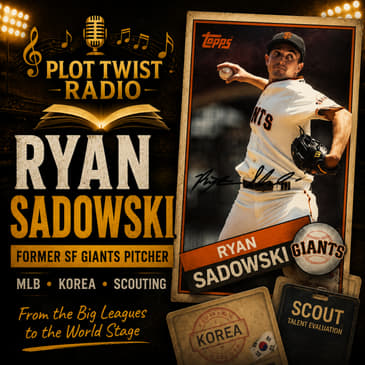
Former San Francisco Giants pitcher and current scout Ryan Sadowski joins Plot Twist Radio for a candid conversation about life in Major League Baseball, pitching overseas in Korea, and what really happens behind the scenes of professional scouting. Ryan reflects on being drafted, making his MLB debut with the Giants, adapting to baseball culture in Asia, and evaluating talent across international leagues.
The conversation also dives into baseball card collecting, Disney fandom, Tokyo Disney, the intensity of the Giants-Dodgers rivalry, and the unique fan atmosphere overseas. From clubhouse stories to career-defining moments, this mini episode offers an honest and entertaining look at the game from someone who has lived it at every level.
#RyanSadowski #SFGiants #MLB #BaseballPodcast #KBO #PlotTwistRadio #BaseballCards #Scouting #MajorLeagueBaseball #SanFranciscoGiants
[00:00:00] Welcome to Plot Twist Radio, the show where creativity, storytelling, and the unpredictable path of the creative life all collide. I'm your host, Erin Egnatz Hi Ryan, welcome to the show. Thanks for having me. Before we get started, could you tell the audience a little bit about yourself?
[00:00:17] Yeah, I am a former baseball player. I work now as a full-time scout and I also have something in common with your husband, which is the love for collectibles. Yes, he is a big baseball card fan. Those baseball cards, he's obsessed. We've had some good conversations about your Disney passion as well. Yes, I have an obsession. It's not his favorite obsession of mine.
[00:00:47] I don't know if he's told you, but I collect some Disney cards. Oh, do you really? Yeah. I have the first card ever of an animated figure and it's an artist. It's from 1931. It's of Walt Disney and Mickey Mouse. Well, that's cool. That's really cool. You're in California now, right? Correct. But you're from Florida? Yeah. Which Disney do you like better?
[00:01:14] Disney World is definitely a more complete experience, but you're less likely to catch bad weather in California. Very true. Very true. I love both of them, but I know when I first went to Disneyland, I was like, this is Bizarro World. It's so weird. But I like it now. I've been out there four or five times now. Just, I love it.
[00:01:35] I work in Japan quite a bit. And when you go by Disneyland Tokyo, it's one of the most interesting places ever because people will be getting on and off the train. And it's like international Disney in this world of Japan. Really? Yeah. Everyone says that it's amazing. I need to get out there. All right. Even though you played for the Giants and I'm a Dodger fan, I appreciate you coming on the show.
[00:02:02] Well, I tell everybody that I was drafted by the Dodgers at a high school and they didn't sign me. So when I got drafted by the Giants out of college, it, you know, being from Florida, I didn't even really understand the rivalry of the Giants and the Dodgers until I got into it. It's very intense. It is. So you were a top high school prospect. When did it hit you that baseball could actually be your career?
[00:02:26] Well, the scout that ended up drafting me out of college when I was in high school, my mom almost called the police on because he was talking about my physique and the way my body moved. And she had no concept of adults talking about kids like that being a profession. But once these scouts started reaching out to me and I saw that I was getting a lot of interest in letters in the mail, I saw that really college baseball was an opportunity which I never really, really thought about.
[00:02:56] And then, you know, professional baseball kind of popped up after that night. I never really aspired to be a professional baseball player. I just I was just happy playing and hoped it would get me into college and eventually, you know, got me to the major league. And it did. So draft day, you, as you said, were drafted by the Giants. What was that moment like for you?
[00:03:19] Well, it was the second time I had been drafted, but at a high school, I really wasn't keen on going to play. I was wanted to continue going to school. So when I got drafted out of out of college, it was it was exciting because it was the start of a career. You know, it was it was all right now. Now this is real. I'm really going to do it. And, you know, it was the draft was one of those things where it wasn't on TV or anything.
[00:03:45] You just kind of waited for your name to be called. And I got a few calls on draft day and eventually the Giants were the ones that took me. But I had heard in upcoming rounds from multiple teams, oh, yeah, we're going to take you here. We're going to take you here. And finally, the Giants took me. Very cool. So you debuted in 2009, correct? That's correct. What do you remember about that first day?
[00:04:13] I remember getting I was actually offered a few days before that a contract from the Yokohama Bay Stars in Japan, and it kind of pushed the Giants to make a decision. And so I thought I was going to Japan. And then a few hours later, I found out I was going to Milwaukee. And then once I got there, you know, you do it so much that it and I was not, you know, I had been in the minor leagues for five years at that point.
[00:04:42] So it was not one of those things where I was overwhelmed or overcome. A lot of my teammates that I had come up with were on the team. So it was one of those one of those situations where you hear about, oh, well, the development of professional baseball, which has changed a lot in the last 15 years. You know, I was pretty comfortable. I was pretty comfortable walking into a clubhouse that had Randy Johnson in it and, you know, other Hall of Famers because I had seen Barry Bonds before that.
[00:05:11] I had seen, you know, Jeff Kent even before that. You know, I would have lunch with Felipe Alou in the minor leagues. Like it was one of those situations where I got there and it was it was just a slightly bigger stadium, but it didn't. And, you know, the players on the other team, I mean, they were really good. The Brewers at that point were a playoff team, World Series contending team. But I just I just kind of approached it like another game.
[00:05:36] It's it's one of like those letdown moments when you tell it to people because they're expecting you to say, oh, yeah, the spectacle, the scene, all this. I was so amazed by it. And I was like, yeah, the stadium was a little bit bigger than Fresno or a little bit bigger than, you know, wherever else it may have been Vegas. But it wasn't it wasn't so overwhelming. I wasn't really overcome by the the situation. That's very interesting because I think I would be terrified. I would just be terrified to do it.
[00:06:05] But I guess if you're so in the zone, you know, you just you're just just another day. Yeah. If it would have been at a high school or I see a lot of these younger players now that just come straight, whether it's straight out of college or, you know, a year or two out of high school, it has to be a different experience for them. And I think it's why you see a lot of players that, you know, have this huge prospect status, not not handle it. And then they have to kind of figure it out on the fly and the clock gets going.
[00:06:32] And it's I feel very fortunate in that that situation that I was not overwhelmed by the situation. Yeah, that is a big deal. I we went to the Cubs game actually yesterday and there was a rookie that came out. And I think I was more nervous than anyone else. And I didn't even care about the game because it wasn't neither of my teams. But I was just like, you know, that's got to be such a great moment to go out there, especially at Wrigley Field, because, you know, it's such a classic.
[00:07:01] Was there a particular field that you'd like to pitch at more than others? San Francisco is one of the most incredible places. It's I've worked at Wrigley Field a few times. It's one of the more uncomfortable places to work because it's an older stadium as is Fenway Park. But San Francisco, it's it's a pitcher's ballpark because of the fog and the humidity and all the conditions that that are there. And then on top of that, it was a home city. It was a place that, you know, I had spent the time.
[00:07:30] So San Francisco and it's an amazing stadium. I tell people all the time that, you know, I don't feel like I'm biased when I tell people that San Francisco is, if not the best ballpark in Major League Baseball, one of the top five. Very cool. I haven't been there, but I really want to go. I'm gonna have to get Nick out there. If I can get him to travel, we'll see. So you made a move. A lot of players don't. You went to the KBO League. What led to that decision? I got taken off the roster when Buster Posey got called up to the major leagues.
[00:08:00] And I had signed with the Houston Astros, but they had given me a January 1st, basically opt out clause. And I had been offered the contract, like I said, the year before by the base stars in Japan. And I had a few offers from Japan and Korea. And my pitching coach was San Francisco at the time was Dave Rigetti. And he called me and he said, the manager of this team in Korea is Jerry Royster. And Jerry was a friend of Rags.
[00:08:29] And he said, I think it's a good opportunity for you. And when you have people that you trust, that know you and, you know, they're looking out for your best interest, then you say, all right, like that, that's legitimate. And I think they knew from my personality that I was not going to be offended by them telling me, hey, you know, it's better to go to Asia and be a guy rather than be the fifth or sixth starter on a major league team where you're just kind of bouncing around.
[00:08:56] And you're going to have more stability being in Pusan than you are, you know, one day you're in Houston, the next day you're in Round Rock. Then the next day you get designated for assignment and claimed by the Cubs and you're in San Francisco. You know, you never know where you're going to be. I didn't have kids at that point, but either way, I felt like the advice that I was getting was good advice. And I took it and ran with it. So how different is baseball culture, I've always wondered this, in Korea or even Asia compared to the U.S.?
[00:09:25] It is much more of a hooligan fan base, kind of like soccer is, where they're cheering and chanting the entire game. And, you know, in Korea and Japan, especially baseball is the biggest sport by far. So you are the guy, you know, like that is the main focus. So, you know, just like anything, there are a lot of similarities in the game. The styles are slightly different.
[00:09:55] Korea is more similar to Major League style than Japan is in terms of the style of the game. But overall, it's just a louder, more, like I said, hooligan style environment. Gotcha. So after playing, you transitioned into scouting. What drew you to that? I was the youngest player ever to go play in Korea, youngest foreign player ever to go play in Korea.
[00:10:22] And I kind of saw that there were players in Korea at the time. You being a Dodger fan, Hyunjin Ryu was one of them that I was like, I remember Jerry actually asked me my first year in Korea. He was like, hey, do you think this guy could pitch in the major leagues? And I was like, Jerry, that guy is so much better than I am. And I was in the major leagues last year. And he was like, really? I was like, that guy's like a frontline starter in the major. That guy's not just like a major leaguer.
[00:10:52] And sure enough, he went to the major leagues and pitched basically as the Dodgers number two or three starter for five years. Then went to Toronto. And there were other players like that, whether it be Jung Ho Kang or Seung Hwan Oh. Or, you know, obviously guys like Otani are transcend what a typical baseball player would see. I don't think it would take somebody who's in tune with baseball to see the difference between me and Otani.
[00:11:17] Whereas with like me and Hyunjin Ryu, if you're in the game, you can see there's a difference. And that was what I saw. And I said, you know, I think that there's a need for there to be people that do this more seriously. And so I started identifying players that would go from the States to Asia and then Asia back to the States. And I created my own little niche of what I did well with scouting.
[00:11:46] Oh, do you evaluate talent differently because you've lived both the both leagues? Yeah, I mean, culture cultures are different in the way players. One of the biggest things that is more important even than the level of play, because everybody that plays in Korea or Japan is a really good player, is the makeup. What type of personality does this player have? And it's not just this guy works hard or doesn't work hard.
[00:12:12] It's how he has conversation, how he's willing to adapt. Or, you know, there are certain guys that don't do well with just culture shock. I had a teammate that only ate McDonald's while he was in Korea. And safe to say it did not go well. Whereas I think I tried just about any food that the team had at team dinner, I gave it a shot.
[00:12:39] It doesn't mean I liked it all, but I don't like every American thing, you know, every American food too. So there's different things that you look for that I think when you experience it gives you a little bit better perspective. Sure. So you now help players make the same transition that you once did. What advice would you give them? Oh, there's a lot of things that I say to guys, and it's funny doing an interview. I always feel like I'm not doing this, but I always say two ears, one mouth.
[00:13:09] You know, listen more than you speak. Like take it in before you spit it out. And then the other thing is, is experience it, you know, like be willing to like and not like things, but kind of do it with an even keel. Because that will help you kind of understand what's going on. Sure. Absolutely. So here's a couple of fast questions.
[00:13:36] What was, who was the hardest hitter you ever faced? Chipper Jones. One moment from your career you wish you could relive. I think just any 27th out, the last out of every, if I, if I ever threw a complete game, those are the moments that I kind of wish I could relive. Makes sense. And lastly, if you weren't in baseball, what do you think you would be doing? Probably more podcasts.
[00:14:04] For sure. Well, I appreciate you joining me today. It's been great. Thanks for having me. Absolutely.